What Is Spinal Decompression, and Who Is It Actually For?
If a disc showed up on your MRI or sciatica has been running down your leg for months, you've probably run across spinal decompression. Here's how it works, who it genuinely helps, and who it isn't right for.
If you've gone looking for spinal decompression in Fayetteville, chances are you already know roughly what you're dealing with. A disc showed up on an MRI. Sciatica has been running down your leg since spring. Or a surgeon laid out a procedure and you'd rather exhaust everything else first. What's usually less clear is whether decompression is the right answer for your particular back — or just the next thing on a list of things you've tried.
This is the honest version: what it does, who it helps, and who it isn't for.
The short version. Spinal decompression uses gentle, computer-controlled traction to take pressure off a compressed disc or an irritated nerve. It helps most with herniated and bulging discs, sciatica, degenerative disc disease, and spinal stenosis. It isn't right for everyone — spinal fractures, severe osteoporosis, spinal tumors, hardware in your spine, and pregnancy all rule it out. And it works as a series of sessions, not a single dramatic fix.
What spinal decompression actually does
Your discs are the cushions between the bones of your spine. They don't have much of their own blood supply, which means they depend on movement and changes in pressure to draw in fluid and nutrients. That's part of why a disc that's been compressed for months or years has such a hard time recovering on its own — the very thing it needs to heal is the thing it isn't getting.
Decompression goes after that pressure directly. A computer-controlled system eases your vertebrae apart by a small amount, holds, and releases, in a slow cycle. That slight separation does two things at once: it takes mechanical pressure off the disc and off whatever nerve the disc has been leaning on, and the gentle pumping action helps draw fluid back in.
None of it is forceful. "Decompression" is an industrial-sounding word, and patients regularly walk in picturing a machine that's going to yank on their spine. The reality is considerably less dramatic than the name.
What it feels like — and why ours is a seat, not a table
Most people picture the traction tables they've seen online: face-down, strapped in at the chest and hips, a motor pulling from one end. That's the common setup, and if imagining it makes you tense up, that's a fair reaction — and a relevant one, because tensing up works against the whole point.
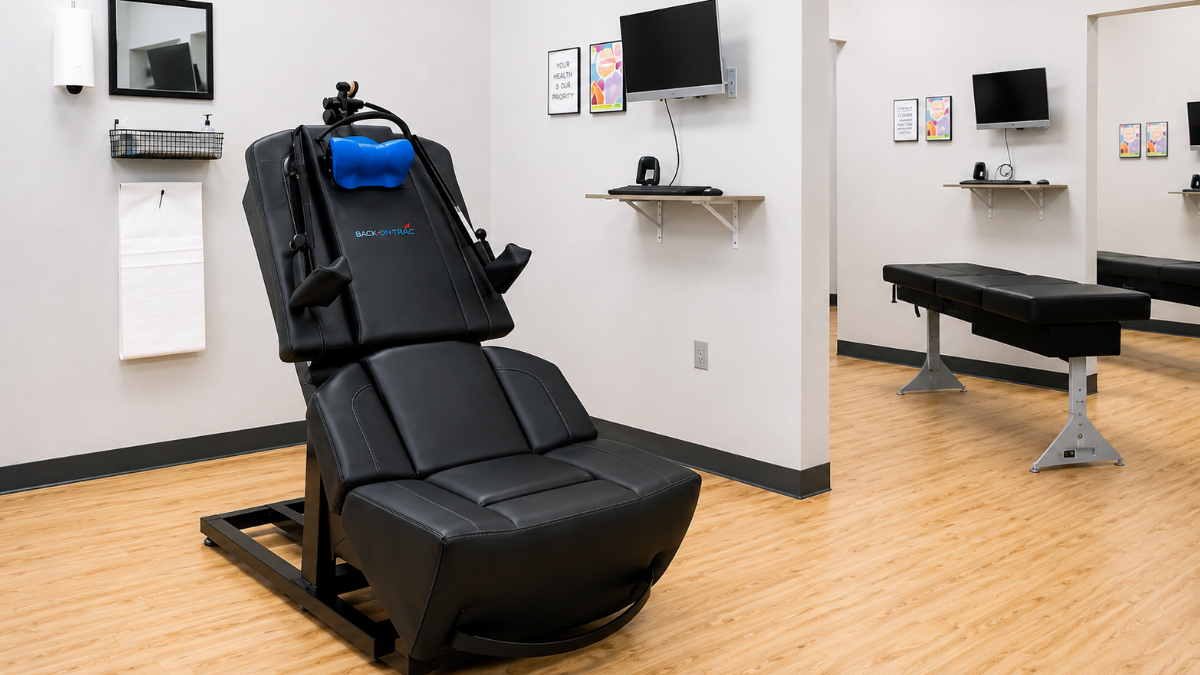
We use the Back On Trac system for the lower back and Cervi-Trac for the neck. Both are seated. No straps, no restraints, nobody lying face-down. You sit, you stay fully clothed, and gentle traction does the work.
That matters more than it might sound. Decompression works best when your muscles aren't guarding against it, and it's a good deal easier to stay relaxed sitting in a chair than strapped to a table. Most of our patients describe the sessions as comfortable. A fair number describe them as the most relaxing part of their week.
The conditions it genuinely helps
Decompression is a pressure problem solver. When the thing driving your pain is a disc or a nerve under compression, it has something to work with:
- Herniated and bulging discs. Creating space between the vertebrae takes the load off the disc and off the nerve it's been irritating.
- Sciatica and leg pain. Worth saying plainly: sciatica is a symptom, not a diagnosis. That shooting, burning, or tingling down your leg is usually a compressed nerve in your lower back announcing itself further down the line. Decompression addresses the compression rather than the sensation.
- Degenerative disc disease. A worn or thinning disc gets relief from pressure, and support for the body's own healing response.
- Spinal stenosis. When the space around your nerves has narrowed, more room is precisely the point.
- Facet syndrome.
- Chronic back and neck pain that's dragged on for months and hasn't responded to rest, stretching, or standard care alone.
Around Northwest Arkansas we see a fairly consistent set of stories behind those diagnoses. Years at a desk in an office off College Avenue. Distribution and warehouse work, and the lifting that goes with it. Farm work that never really stops. Students hauling loaded packs across the U of A campus. Long stretches behind a wheel on I-49. None of that causes disc problems on its own — but sustained load on a spine that's already compromised tends to be what finally makes it impossible to ignore.
Who it isn't for
This part deserves to be as clear as the rest, because the internet is not overflowing with clinics volunteering it.
Spinal decompression may not be appropriate if you have:
- A spinal fracture
- Severe osteoporosis
- A spinal tumor
- Metal implants or hardware in your spine
- A pregnancy in progress
There's also a broader point underneath that list. Even with none of those on your chart, decompression only makes sense if compression is what's actually driving your pain — and plenty of back pain isn't disc pain. If your exam points somewhere else, we'll tell you that and recommend something else. A treatment aimed at the wrong problem is just an expensive way to stay in pain.
If you're pregnant and dealing with back pain, that's not a dead end — it's a different conversation, and prenatal chiropractic care is built for it.
What a real course of care looks like
Decompression is not a one-visit fix, and you should be skeptical of anyone who implies it is. Relief from disc and nerve pressure builds gradually, which means it works as a series of sessions.
How many depends on your condition and how long you've been living with it. That number comes out of your evaluation, not out of a brochure.
Getting there follows the same new patient process everyone here goes through — looking into decompression doesn't put you on a separate track:
- A free consultation. We sit down and talk through your pain, how long it's been going on, what you've already tried, and what you're hoping to get back to doing.
- Comprehensive exam. Neurological testing, orthopedic assessment, and spinal analysis. We're looking for the underlying pattern, not just the spot that hurts.
- Digital X-rays, if needed. Taken right here in the office when we need to see the structure of your spine to care for you safely. Bring any imaging you already have.
- Report of findings. Your doctor walks you through what we found in plain language — including a straight answer on whether decompression is a good fit for you.
- Care plan. What we recommend, how often, over what stretch of time, what we expect it to accomplish, and what it'll cost. Then it's your call.
How those steps fall across your appointments depends on your situation — some get done the same day, others at a follow-up. The order never changes, though, and you'll always know what's coming next.
The free consultation isn't a formality — it's the screening step, and it comes first for a reason. If that conversation makes clear decompression isn't the right answer for you, we stop there. We won't run you through the rest of the workup for a treatment we don't believe will help you.
One more thing that surprises new patients: we don't start decompression before the report of findings. Understanding the problem comes first, always. We'd rather work out exactly what we're treating than start treating on a hunch — so you'll know what we intend to do, and why, before any of it happens.
On cost: many insurance plans cover spinal decompression as part of chiropractic care, but coverage varies enough plan to plan that the only reliable answer is a phone call. Give the office a call at (479) 435-6888 and we'll verify your specific benefits.
How it fits with regular chiropractic care
Decompression usually isn't a standalone treatment, and it works best as part of a bigger plan.
Our care at Abide is neurologically-based — the focus is on clearing interference in the nervous system so your body can do what it's designed to do. A chiropractic adjustment addresses alignment and nerve interference. Decompression addresses pressure inside the disc itself. They're aimed at different parts of the same problem, and for a lot of our patients the two together accomplish what neither does alone.
So — is it right for you?
You're a reasonable candidate to at least ask the question if:
- You have a diagnosed disc problem, or symptoms that point to one
- Rest, stretching, and standard care haven't moved the needle
- Surgery has come up and you'd like to exhaust the alternatives first
- None of the conditions in the list above apply to you
You don't need an MRI or a diagnosis in hand to come find out — that's what the evaluation is for, and the consultation that answers the question costs nothing.
Find out whether decompression is right for your back
Read the full details on our spinal decompression page, then schedule an appointment — the consultation is free, and it's the only way to get an answer specific to your spine rather than a general one. If you'd rather talk it through with a person first, call us at (479) 435-6888. Our office is at 3761 Mall Ave, Suite 3, here in Fayetteville.
Common Questions
How is spinal decompression different from getting adjusted?
They solve different problems. An adjustment is a quick, specific correction that restores proper alignment and clears nerve interference. Decompression is sustained, gentle traction that takes pressure off a disc over the course of a session. Many of our patients receive both as part of one care plan.
Is spinal decompression the same as an inversion table?
No. An inversion table uses your own body weight and gravity, with no control over how much traction is applied or where. Decompression is computer-controlled and targeted to a specific segment of your spine, with the force adjusted to what your body can handle and released in cycles. The Back On Trac and Cervi-Trac systems we use are also seated, so you're not hanging upside down.
Do I need an MRI or a diagnosis before I come in?
No. Bring any imaging or records you already have, since they help. But the evaluation exists precisely to work out what's going on, and plenty of patients arrive knowing only that their back hurts.