How to Choose the Best Chiropractor in Fayetteville
Every chiropractic office in Fayetteville has five stars and a friendly team photo. Here are the differences that actually matter — and how to check them before you book.
Search "best chiropractor in Fayetteville" and you'll get a list. Ads across the top, a map with three offices on it, then page after page of directories that sorted everyone by star average and called it a day.
From the outside, every practice looks about the same. Five stars. A smiling team photo. Now accepting new patients. None of it tells you the thing you actually want to know, which is whether this particular office is right for your neck, or your pregnancy, or your seven-year-old, or your dad's hip.
So here's the honest version: there's no single best chiropractor in Fayetteville. There's a best fit for you and what you're dealing with. The good news is that fit isn't a mystery. The differences between two chiropractic offices are real, they're specific, and almost all of them can be checked before you ever sit in a waiting room. Most people just don't know what to look for.
The short version. "Best" is a fit question, not a ranking. Six things actually separate chiropractic offices in ways you'll feel: how they adjust (hands-on cracking versus low-force instrument or drop-table work), what happens before your first adjustment (are you examined and told what they found, or adjusted on day one?), what they think is causing your problem (the sore spot, or the nervous system running it), what they can do besides adjust you — this one decides everything if your problem turns out to be a disc, because an office without spinal decompression on site has to refer you out — credentials that match your situation (pregnancy, kids, athletes, seniors), and whether the plan gets explained to you in plain language. Reviews matter too — just read them for patterns, not for the star average. Every one of these is checkable with one phone call.
Reviews tell you more than the star rating does
Nearly every chiropractor in Fayetteville has a high star average. That's the part people look at, and it's the least useful part, because it doesn't separate anybody.
What's useful is the words. Skip the number and read twenty actual reviews, looking for whether people describe the same things over and over. Do multiple reviewers mention being listened to? Being examined thoroughly? Having things explained instead of just done to them? Not feeling pushed into a package? Those repeated details are an office's real character showing through, and they're much harder to manufacture than a rating.
Then read for fit, which is the part almost nobody does. If you're pregnant, look for reviews from pregnant patients. If you're bringing a toddler, look for parents. If you're 68 with arthritis, find someone who sounds like you. An office can be genuinely excellent and still not be the one for your situation — and the reviews will usually tell you which situations it's used to handling.
Volume is worth a glance too. A dozen five-star reviews tells you a dozen people were happy. A couple hundred of them, held steady over years and across a lot of different patients with a lot of different problems, is harder to fake. We're at 4.9 stars from more than 225 patients, which makes us one of the highest-rated practices in Fayetteville — but read the words before you read the number, on our page and on everyone else's.
Start with how they adjust
This is the biggest practical difference between two chiropractic offices, and it's the one almost nobody thinks to ask about.
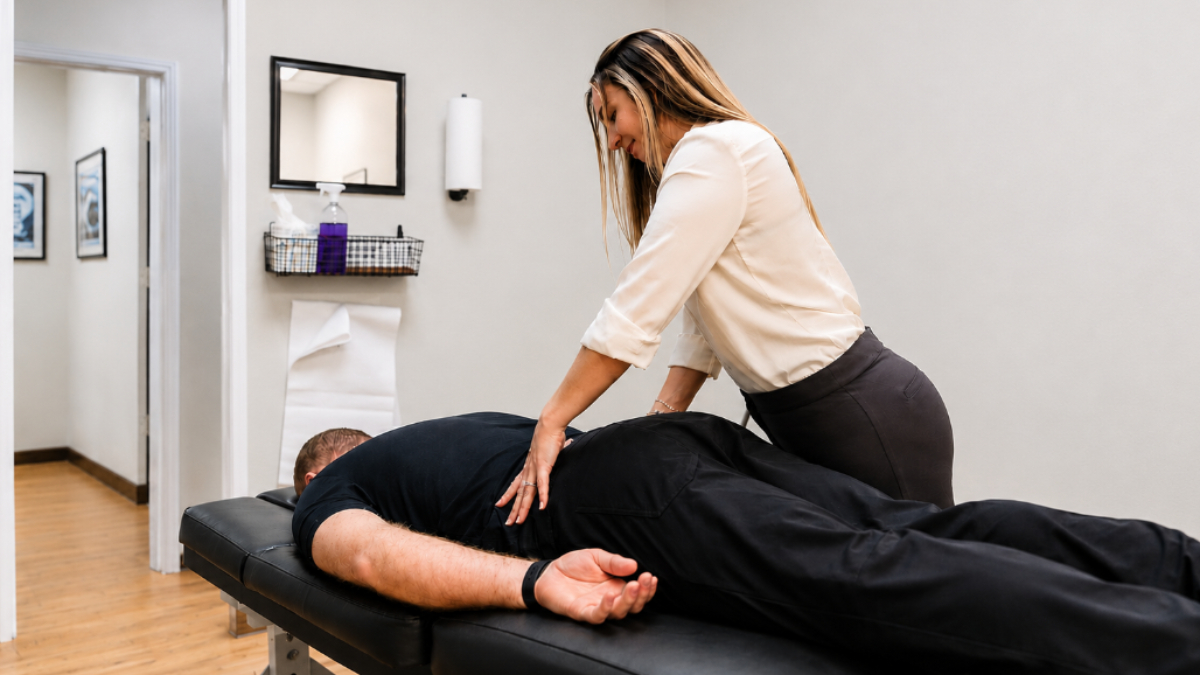
Some chiropractors adjust entirely by hand, with the twist-and-pop most people picture when they hear the word "chiropractor." Others use low-force instruments that deliver a small, specific input with no forceful twisting at all, or drop-piece tables that do the work with very little pressure. All of it is legitimate. But it feels completely different, and if the idea of your neck being cracked is what's kept you out of a chiropractic office — a lot of people feel that way, and it's a perfectly reasonable thing to feel — that difference decides whether you'll actually keep your appointments.
So ask two questions. What technique do you use? And then: do you have more than one?
The second one matters more than it sounds. An office with a single method has to fit every patient to it. An office with a few can fit the method to the patient.
At Abide we use several, and we pick based on you. Our chiropractic adjustments include Diversified, the hands-on technique most people know; Torque Release Technique, which is instrument-assisted and low-force for patients who want a lighter touch; and Thompson Drop, which uses a table with drop pieces so the correction happens with minimal force. Kids get something gentler still — roughly the pressure you'd use checking a tomato for ripeness. Expecting mothers get the Webster Technique, which is built around pregnancy from the ground up rather than adapted to it.
If the thought of being cracked is the thing keeping you out of a chiropractor's office, that's a technique question — not a reason to stay away. Ask what your options are. Any office worth going to will answer plainly and won't be offended you asked.
Find out what happens before your first adjustment
Here's the one that separates offices faster than anything else on this list.
There's a version of chiropractic built for speed. Walk in, get adjusted, walk out, come back Thursday. It's efficient, and for some people it's genuinely fine. But it means somebody made a decision about your spine before really looking at it.
So ask directly: will I be examined before I'm adjusted? If the answer is "we'll get you adjusted and see how you feel," you now know what kind of office it is. That's not a scandal — it's just information, and it's yours to weigh.
At Abide the order never varies:
- A free consultation — a real conversation about what brought you in, how long it's been going on, and what you're hoping to get back to doing
- A comprehensive exam — neurological testing, orthopedic assessment, spinal analysis
- Digital X-rays if the exam says we need to see the structure, taken right here in the office
- A report of findings, in plain English — what's going on, what's causing it, what we think it'll take to correct
- A care plan — what we recommend, how often, over what stretch of time, and what it costs
- Your first adjustment
How those steps fall across your appointments depends on your situation. Some get done the same day, others at a follow-up. What never changes is the order — your first adjustment always comes after your report of findings, never before it. We'd rather understand exactly what we're correcting than start on a hunch, and you should know exactly what you've agreed to before any of it happens. If you want the full walkthrough, it's in what to expect as a new patient.
One more thing worth knowing, because it cuts the other way: that free consultation is a screening step, not a formality. If it becomes clear you're not a good candidate for what you came in about, we say so and stop there rather than running you through the rest of the workup.
Ask what they think is actually causing it
Two offices can use the same word for very different jobs, and this is where the difference lives.
One approach treats the place that hurts. Your lower back is angry, so care is aimed at your lower back. It can work, and for a straightforward strain it's often all you need.
The other approach starts a step earlier and asks why that spot is under strain in the first place. The nervous system runs everything — every muscle, every organ, every signal about how your body holds itself up. When a spinal misalignment interferes with those signals, the pain you feel is downstream of the actual problem. Treat only the pain and you'll be back. That's what neurologically-based care means, and it's how we practice at Abide.
Neither model is wrong, but they lead to different care and different timelines, and you should know which one you're buying. Ask the question plainly: what do you think is causing this, and what are you actually correcting? A clear answer is a good sign no matter which model it comes from. A vague one is worth paying attention to.
Ask what they can do besides adjust you
Most chiropractic offices in Fayetteville offer one thing: adjustments. That's not a criticism — adjustments are the core of chiropractic and they resolve a great many problems on their own. But it matters enormously if your problem is a disc.
Herniated and bulging discs, sciatica, degenerative disc disease and spinal stenosis all come down to something pressing where it shouldn't — a disc on a nerve, a narrowed space, pressure that's been building for months or years. Adjustments help those cases. Often they aren't the whole answer. And if the only tool an office has is an adjustment, your realistic options are to keep going and hope, or to get sent somewhere else, which usually means a referral, a wait, and starting over with a new provider who hasn't examined you.
So ask: if this turns out to be a disc, what happens then — do you treat it here, or do I get referred out?
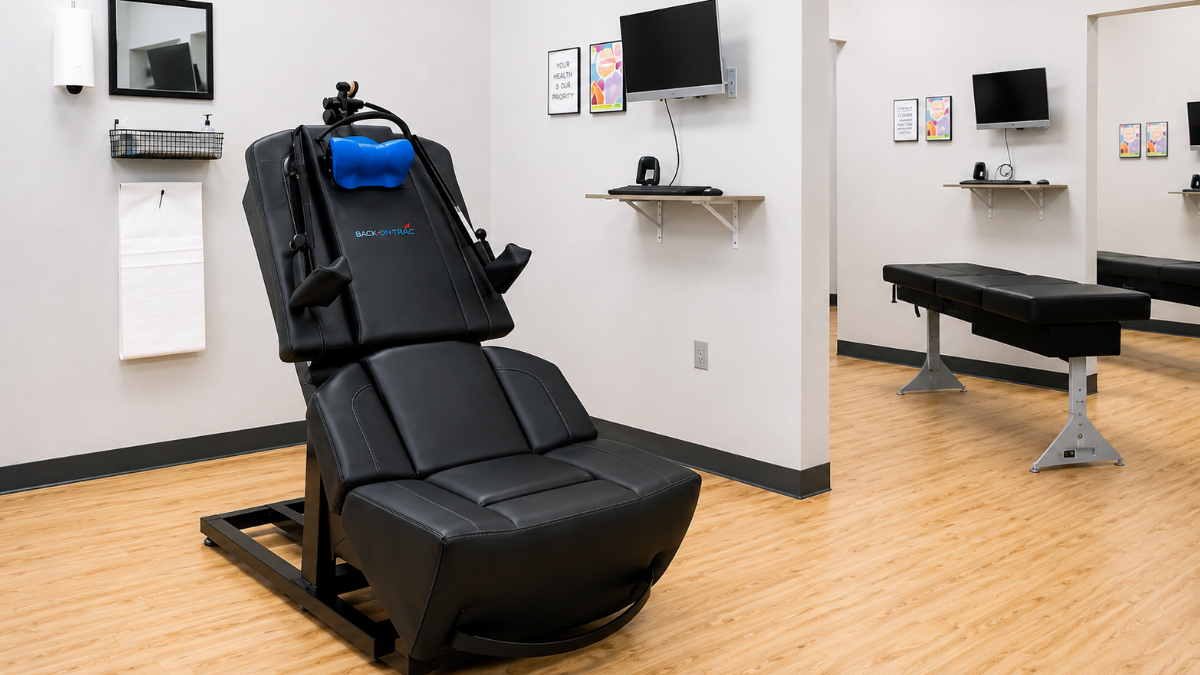
This is where Abide is genuinely different from most offices in town. Spinal decompression is here, in this building, as part of the same care plan and the same doctors who examined you. It uses gentle, computer-controlled traction to take pressure off a compressed disc or an irritated nerve — the opposite of a quick correction, and a real non-surgical option for people who've been told surgery is next. Plenty of our patients have avoided an operation entirely this way.
Two things worth knowing about how ours works, because "decompression" covers some very different experiences:
- You sit up, and you're not strapped in. We use the Back On Trac system for the lower back and Cervi-Trac for the neck. Both are seated. No straps, no restraints, nobody lying face-down, and you stay fully clothed. If you've seen photos of someone belted to a table at the chest and hips, that's a different setup than this one. Most patients describe the sessions as relaxing.
- It's a series, not a single dramatic fix. Disc and nerve pressure comes off gradually, so decompression works over a course of sessions. Any office that promises you one visit and you're fixed is selling something.
It also isn't for everyone, and that's the part worth asking about hardest. Spinal fractures, severe osteoporosis, spinal tumors, hardware in your spine and pregnancy all rule it out. An office that tells you that up front is an office that examined you. If you want the long version, we wrote a whole piece on what spinal decompression is and who it's actually for.
The broader point holds even if discs aren't your problem: ask what an office can do when adjustments alone aren't the answer. Alongside decompression, we handle neuropathy — the burning, numbness and tingling that isn't a sore muscle and needs its own protocol — and sports injuries. Depth of options is a fair thing to compare, and it's rarely on anyone's website in a form you can compare directly. Just ask.
Match the credentials to your situation
"Best chiropractor" almost always means best for a specific person with a specific problem. Which credentials matter depends entirely on who's getting adjusted.
- Pregnant? Ask whether they're Webster Certified. It's a real post-doctoral credential from the ICPA, earned through training and an exam, and most chiropractors don't hold it. Ask about X-ray policy during pregnancy too — the answer should be an immediate no. (Dr. Watkins is Webster Certified, we don't X-ray during pregnancy, and Dr. Nowak is trained in prenatal and Webster adjustments if you'd prefer a female doctor. More on pregnancy care, or read our full guide to the Webster Technique.)
- Bringing a child? Ask about pediatric training specifically. Adjusting a six-year-old has almost nothing in common with adjusting a grown adult, and the amount of force involved should sound surprisingly small when they describe it. (More on pediatric chiropractic.)
- An athlete, or a Razorback with a season to get through? Ask whether they routinely handle sport-specific problems and what they do beyond the spine. (More on sports injury treatment.)
- Over 60, or dealing with arthritis or thinning bone? Ask straight out how they adapt care for a body that can't take a forceful adjustment. A low-force option — instrument or drop-table work — matters a lot here, and an office that only has one gear will struggle to answer.
And one people don't think to ask until it's a problem: can the whole family be seen in the same place? If you've got a toddler, a teenager with a sports injury, and a spouse with a desk-job neck, three offices with three different schedules is a genuine reason care quietly stops happening. Family wellness is the bulk of what we do, and it's mostly a logistics advantage rather than a clinical one — but logistics are what keep people coming.
Pay attention to how the plan gets explained
After the exam, you should get a clear answer to three questions: what's going on, what you'd do about it, and roughly how long it should take. In language you can repeat to your spouse that night without stumbling over it.
Two warning signs, both worth taking seriously.
Vagueness. If nobody can tell you what they found or how you'll both know it's working, there's nothing to hold them to later.
Pressure. A long-term plan presented as all-or-nothing, with a discount that expires if you don't sign today, is a sales structure — not a clinical finding. Real recommendations survive you going home to think about it.
You should always be able to say "let me think about it" and get a genuinely friendly response. The decision about your care is yours, every time, and it doesn't stop being yours after you say yes once.
The practical details that decide whether you actually go
Unglamorous, but this is where good intentions go to die. The best chiropractor in Fayetteville is the one you'll still be seeing in six weeks.
- Drive time, at the hour you'd actually come. We're at 3761 N Mall Ave, Suite 3, just off College near the mall — an easy run from most of Fayetteville and a manageable one from Springdale, Johnson, Elm Springs, Tontitown, and Lowell. But check it from your place at your time, not at noon on a Sunday.
- Hours that fit your life. Ask about the specific days and times you'd realistically book, not the general range. Ours are Monday, Wednesday and Thursday from 10–12 and 3–6, and Tuesday mornings from 8–12. We're closed Fridays, which is worth knowing up front if Friday is the only day you can get away.
- Insurance and cost, up front. Ask what they take, and ask what a visit costs if they don't take yours — that second question is the one that gets skipped. We accept most major plans and offer flexible payment options, and no referral is needed to be seen. Coverage varies enough plan to plan that the only reliable answer is a phone call.
- How rescheduling works. You'll need to move an appointment at some point. Find out now whether that's easy or a production.
Questions worth asking on your first call
If you only do one thing from this article, do this one. Five minutes on the phone will tell you more than an hour of reading directories:
- What technique do you use, and what does it feel like?
- Will I be examined before I'm adjusted?
- Do you take X-rays, and how do you decide when they're needed?
- What do you think is causing a problem like mine, and what would you be correcting?
- If it turns out to be a disc, do you treat that here or refer me out?
- Do you have specific training for [pregnancy / kids / sports]?
- What insurance do you take, and what does a visit cost if you don't take mine?
You'll learn as much from how they answer as from what they say. Clear, unhurried answers to plain questions are a good sign. Hesitation on any of these is an answer too.
A good chiropractor will also tell you when the answer isn't chiropractic
This is last on the list and honestly one of the most important.
Chiropractic helps a lot of people with a lot of things. It isn't the right answer for everything, and an office that behaves as though it is should give you pause. Some problems belong with a medical doctor, an orthopedist, a physical therapist, or an emergency room — and sometimes the most useful thing a chiropractor can do is say so on day one and point you where you need to go.
We'd rather tell you plainly that we're not the right fit than take you on and hope. If your consultation or exam turns up something that belongs with another provider, we'll say so and help you get there. That's not us turning down work — it's the entire reason we examine you first.
Come see whether we're the right fit
You can research chiropractors in Fayetteville all week. At some point the only way to know is to sit in the room and see how you're treated.
If what you've read here sounds like the care you've been looking for, come find out. Start with our new patient page for the full details, then schedule an appointment at a time that works for you. Or call us at (479) 435-6888 and ask us every question on that list — that's genuinely fine, and it's usually the fastest way to get a straight answer. And if we're not the right fit for you, we'll tell you that too.
Common Questions
How do I know if a chiropractor is right for me before I book?
Call and ask five things — what technique they use and what it feels like, whether you'll be examined before you're adjusted, what happens if your problem turns out to be a disc, whether they hold credentials that match your situation (pregnancy, kids, sports), and what a visit costs if they don't take your insurance. You learn as much from how they answer as from what they say.
Will I get adjusted on my first visit?
At Abide, not before we've examined you, explained what we found, and you've agreed to a plan — and that's deliberate. Your first adjustment always comes after your report of findings. Whether that lands the same day or at a follow-up depends on your situation. It's worth asking any office you're considering, because plenty of them will adjust you on day one.
Do I need a referral to see a chiropractor in Fayetteville?
No. You can book directly with us, and we accept most major insurance plans. Coverage varies enough plan to plan that the only reliable answer is a phone call — (479) 435-6888.
What's the difference between a "gentle" chiropractor and a regular one?
Usually technique. Some adjust entirely by hand, with the twist-and-pop most people picture. Others use low-force instruments or drop-piece tables that deliver a specific correction with very little force. Both are legitimate — they just feel completely different. We use both and match the method to the patient, so being nervous about being cracked isn't a reason to stay away.
Do all chiropractors offer spinal decompression?
No — most offer adjustments only, which matters if your problem turns out to be a disc, because it means being referred somewhere else. We have spinal decompression on site using the seated Back On Trac and Cervi-Trac systems, so a herniated disc, sciatica or stenosis gets handled here, by the same doctors who examined you, as part of the same care plan. Ask any office you're considering what happens if it's a disc.
Does a higher star rating mean a better chiropractor?
Not on its own. Nearly every chiropractor in Fayetteville has a high star average, so it doesn't separate anybody. What's useful is reading the actual reviews for patterns — whether people describe being listened to, being examined thoroughly, not being pressured — and whether the reviewers sound like you and the problem you've got.