Why Your Feet Burn at Night — and How We Treat Neuropathy in Fayetteville
That hot, prickling burn in your feet that shows up the moment you lie down has a name — and the reason it's worse at night is real, not imagination. Here's what neuropathy is, what causes it, and what can actually be done about it.
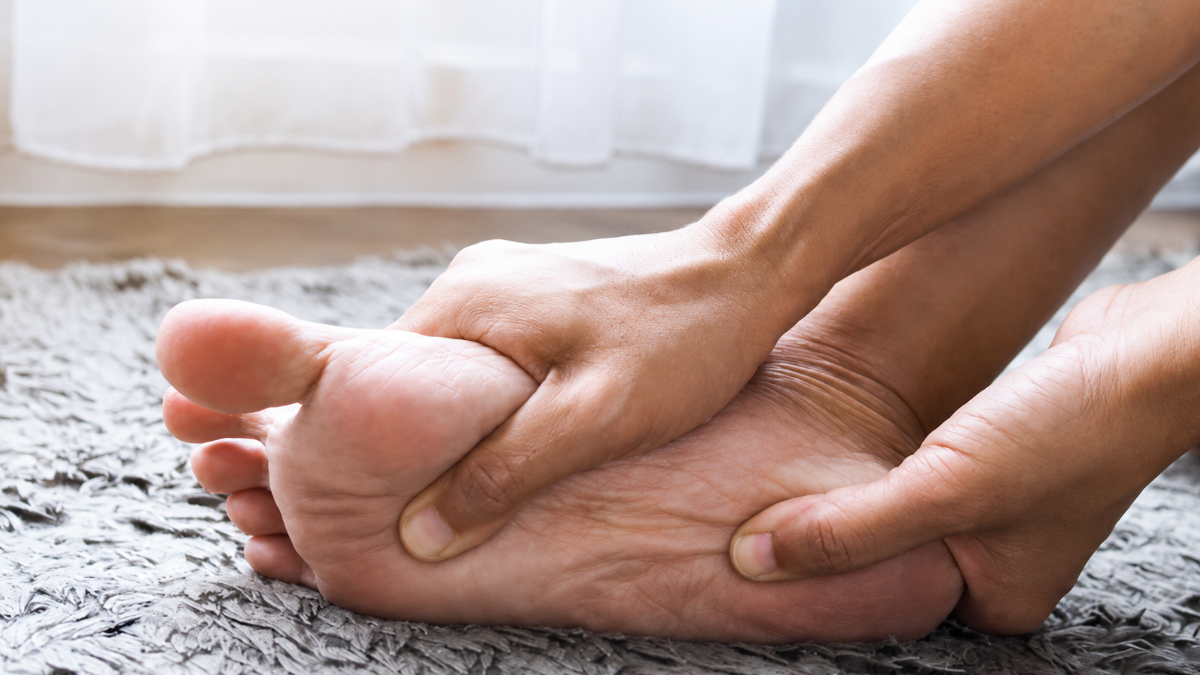
Everybody else in the house is asleep. You've been lying there for an hour. And your feet are doing the thing again — that hot, prickling, electric burn that wasn't there all afternoon but shows up the second you stop moving.
If that's you, you've probably already worked out that it isn't your shoes and it isn't a circulation problem you can rub out. What you may not have been told is that it has a name, that the reason it's worse at night is a real physiological thing and not your imagination, and that "take this and learn to live with it" isn't the only option on the table.
It's one of the more common things we see at our office here in Fayetteville — people who've been living with burning or numb feet for years, who've been told it's just something to manage, and who've never had anyone actually examine what's driving it.
The short version. Burning, tingling, or numbness in your feet and hands is usually peripheral neuropathy — damage or dysfunction in the nerves that carry signals between your spine and your extremities. It gets louder at night because your skin warms up, you stop moving, and nothing's competing for your attention. Diabetes is the most common cause, but injuries, vitamin deficiencies, autoimmune conditions, infections, and spinal misalignment all drive it too. It's treatable without medication in a lot of cases — we combine FDA-cleared Anodyne light therapy and ReBuilder nerve stimulation with neurologically-based chiropractic care and targeted nutrition. How much of it we can reverse depends on what's causing it and how long it's been going on, and the free consultation exists to give you a straight answer on that before you commit to anything.
What neuropathy actually is
Your nervous system runs on signal. Your brain sends instructions down the spinal cord, out through the nerves, to every muscle and patch of skin you've got — and those same nerves carry information back the other way. Temperature, pressure, pain, where your foot is in space. All of it travels the same wiring.
Peripheral neuropathy is what happens when that wiring gets damaged or stops working properly. "Peripheral" just means the nerves out at the edges of the system — the ones with the longest run from the spinal cord to their destination. That's why it almost always starts in the feet. Those nerves are the longest in your body, which makes them the first to struggle when something is interfering with their function or their blood supply.
When a nerve is damaged, it doesn't simply go quiet. It misfires. That's the part people find hardest to explain to family — how a foot can be numb and screaming at the same time. A nerve that's lost the ability to report accurately will report anyway, and what it sends up the line comes through as burning, buzzing, pins and needles, or pain from things that shouldn't hurt at all. The weight of a bedsheet, for instance.
The usual signs, in roughly the order people notice them:
- Tingling or "pins and needles" in the toes or fingers
- Numbness, or a feeling like you're walking on a sock that isn't there
- Burning pain, especially at night
- Sharp, stabbing, or electric-shock sensations
- Skin that's painful to touch
- Muscle weakness in the feet, ankles, or hands
- Balance trouble, or catching yourself more than you used to
That last one deserves more weight than it usually gets. If your feet can't tell your brain where the floor is, your balance suffers — and a fall is a considerably bigger problem than the tingling that preceded it.
Why it gets worse the moment you lie down
This is the single most common question we hear about neuropathy, and there are three explanations behind it. All of them are real, and for most people it's some combination.
Your skin gets warmer. Your body temperature regulation shifts in the evening, and your skin temperature actually rises slightly as you settle in for the night. Damaged nerve fibers tend to be temperature-sensitive, and warmth makes irritated ones fire more readily.
You stop moving. During the day, movement keeps blood flowing to your feet. When you've been still for a while, circulation to the extremities drops — and nerves that are already struggling for oxygen and nutrients struggle harder.
Nothing else is competing. During the day your nervous system has a hundred inputs to process. At 11pm, in a dark quiet room, the only signal in the queue is the one coming from your foot. The pain isn't necessarily worse; the volume knob on your attention is turned all the way up.
None of that means the nighttime burn is "just in your head." It means the conditions at night are the ones your damaged nerves handle worst — which is useful information, because circulation and nerve signaling are both things treatment can act on.
What's actually causing it
Neuropathy is a description of what's happening, not a diagnosis of why. Getting the why right is the whole ballgame, because it determines what's likely to help.
- Diabetes. The most common cause by a distance. Sustained high blood sugar damages the small blood vessels that feed your nerves, and the nerves starve. This is why diabetic neuropathy starts in the feet and works its way up.
- Nutritional deficiency. B-complex vitamins in particular are structural to nerve health. B12 deficiency is a genuinely common driver, and it's frequently missed — it can also be caused by medications people have been taking for years without anybody connecting the two.
- Injury and compression. A nerve that's been physically compressed — by an injury, by repetitive work, or by a spinal problem — doesn't function properly downstream from the compression.
- Spinal misalignment. Nerves exit the spinal cord through openings between the vertebrae. If a vertebra isn't sitting where it should, it can interfere with the nerve passing through, and everything that nerve serves gets a degraded signal. This is the one most commonly overlooked, and it's the one chiropractic addresses directly.
- Autoimmune conditions and infections, which can attack nerve tissue or the myelin sheath around it.
- Chemotherapy and certain other medications, which can be neurotoxic.
- Alcohol use over a long period, both directly and through the nutritional deficiencies that tend to come with it.
A fair number of the people we see have more than one of these going at once — and a fair number have been told their cause is "idiopathic," which is a medical term meaning nobody's found it yet. That's not the same as there being nothing to find.
Around Northwest Arkansas we see a fairly consistent set of stories behind the diagnosis. Years on a poultry or food processing line, doing the same motion at the same speed. Long hauls up and down I-49. Warehouse and distribution work that keeps you standing on concrete through a full shift. Decades at a desk in an office off College Avenue. Retirement in Fayetteville after a working life that asked a great deal of a body.
And type 2 diabetes, which we encounter more than any other single driver — often in people managing it well, who had no idea their feet were part of the same picture.
None of that causes neuropathy on its own. But it's the kind of sustained load that takes a nerve which is already compromised and makes it impossible to ignore.
Why "learn to live with it" isn't the only answer
Here's the conversation we hear about most often. You bring up the burning at an appointment, you get a prescription for gabapentin or something in that family, and you get some version of "this is manageable but it's not really fixable."
That medication has a real place, and nothing here is an argument for stopping something your physician has you on. But it's worth being clear about what it does: it changes how your nervous system transmits the pain signal. It turns down the volume. It doesn't do anything about the circulation problem, the nerve damage, or the interference that's generating the signal in the first place.
Which is why people on it often describe the same thing — the burning is quieter, and the numbness and the balance trouble are exactly where they were.
Our care at Abide is neurologically-based. The premise is Above-Down-Inside-Out: your body is built to heal itself, and it does that through the nervous system. When that system is running without interference, function improves. So instead of working on the pain signal, we work on the three things that determine whether a damaged nerve can actually recover — the signal reaching it, the blood supply feeding it, and the raw material it needs to rebuild.
What treatment actually involves
Four pieces. Which ones you get, and in what combination, comes out of your evaluation.
Neurologically-based chiropractic adjustments
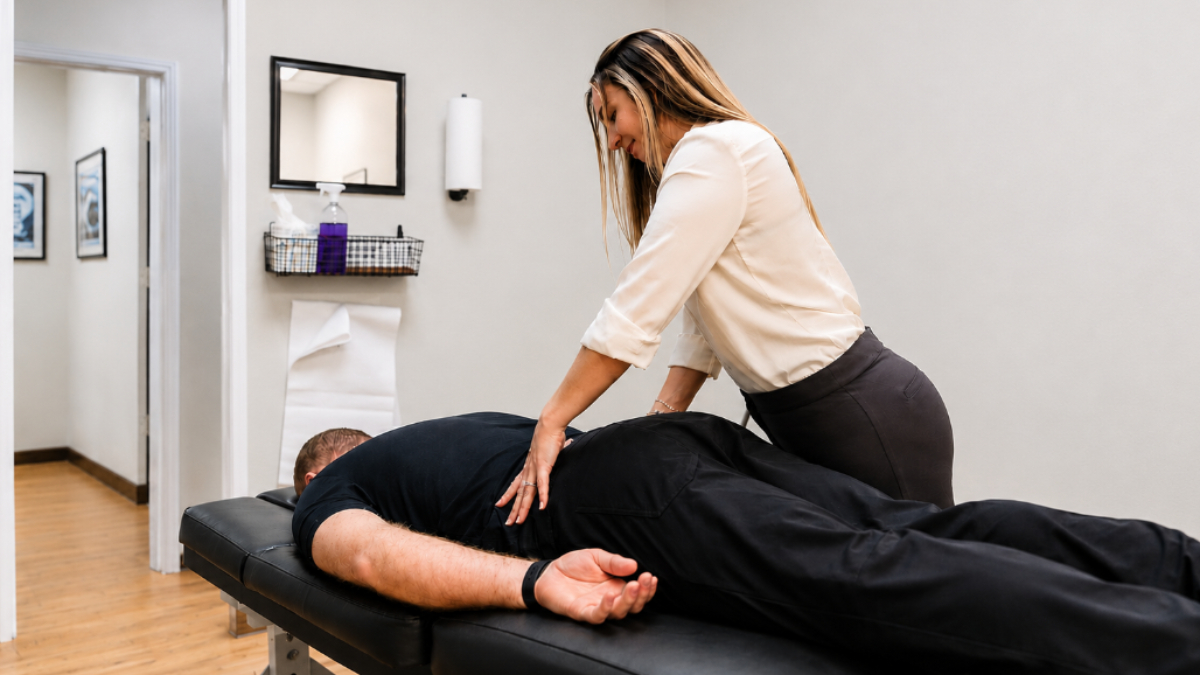
If part of what's driving your neuropathy is a spinal misalignment interfering with the nerve at its root, no amount of work on the foot is going to fix it. Specific, gentle chiropractic adjustments restore proper alignment and clear that interference, so the nerve gets a clean signal for the first time in possibly years. This is the foundation the rest of it sits on.
Anodyne Freedom 300 — infrared light therapy
FDA-cleared infrared light therapy, delivered through pads that wrap your feet and calves. You sit still for about 30 minutes with nothing required of you — it's hands-free, and patients generally describe it as pleasantly warm and not much else.
What it's doing is increasing circulation to the tissue. That matters for the reason covered above: nerves that aren't getting adequate blood supply can't repair themselves, and improving local circulation gives the tissue what it needs to heal, while easing pain and stiffness along the way.
ReBuilder — electronic nerve stimulation
The ReBuilder is FDA-cleared, has over 40 years of development behind it, and is used by more than 55,000 doctors nationwide.
The distinction that matters: this isn't a TENS unit. A TENS unit masks pain by flooding the nerve with a competing signal, which works exactly as long as it's switched on. The ReBuilder works through a four-step process instead — improving circulation, calming irritated nerves, retraining nerve function, and supporting relief that holds. It's aimed at what the nerve is doing, not at what you're feeling.
96% of ReBuilder patients report less pain after just 10 sessions of neuropathy treatment.
Blueprint Nutrition
If a deficiency is part of what's damaging your nerves, that gap has to be closed or everything else is working uphill. We offer a professional-grade Blueprint Nutrition protocol — B-complex vitamins, Alpha Lipoic Acid, Omega-3s, and magnesium — built around what your case actually needs rather than handed out uniformly.
Who this helps — and who it doesn't
The honest version, because this is where a lot of neuropathy marketing gets slippery.
This approach has the most to work with when:
- Your symptoms are in your feet and hands — burning, tingling, numbness, weakness
- Compromised circulation or nerve interference is part of what's driving it
- You've been offered medication and want something aimed further upstream
- You've been told there's nothing else to be done and haven't had a neurological and spinal evaluation to confirm that
Be more cautious if:
- Your neuropathy is from an active, progressing underlying disease. Uncontrolled blood sugar is the clearest example — we can support the nerve, but if the cause is still doing damage, care here works alongside your physician's management, not instead of it.
- The nerve damage is advanced and long-standing. Nerve tissue repairs slowly, and there's a point past which some loss is permanent. We'd rather tell you that up front than sell you a plan around it.
And the broader point: complete reversal depends on the underlying cause and the severity, and anybody promising you a cure without having examined you is telling you something they can't know. What we see regularly is significant improvement in symptoms — less burning, feeling returning, better balance, sleeping through the night. That's a real outcome and it's worth pursuing. It just isn't the same sentence as "cured," and we're not going to blur the two.
If your evaluation points somewhere other than what we treat, we'll tell you that and point you where you need to go. A treatment aimed at the wrong problem is just an expensive way to stay in pain.
What a real course of care looks like
Neuropathy care is a series, not an event. Nerve tissue recovers slowly by nature, and anyone implying otherwise is worth being skeptical of. How long yours takes depends on the cause and how long you've been living with it — some patients notice a difference within weeks, others are working at it over several months. That number comes out of your evaluation, not out of a brochure.
Getting there follows the same new patient process everyone here goes through. Coming in about neuropathy doesn't put you on a separate track:
- A free consultation. We sit down and talk through your symptoms, how long they've been going on, what you've already tried, and what you're hoping to get back to.
- Comprehensive neurological exam. Neurological testing, orthopedic assessment, and spinal analysis, aimed at working out what's actually driving your nerve dysfunction.
- Digital X-rays, if needed. Taken right here in the office when we need to see the structure of your spine to care for you safely. Bring any records or imaging you already have.
- Report of findings. Your doctor walks you through what we found in plain language — including a straight answer on whether we think we can help, and which of the four pieces above fit your case.
- Care plan. What we recommend, how often, over what stretch of time, what we expect it to accomplish, and what it'll cost. Then it's your call.
How those steps fall across your appointments depends on your situation — some get done the same day, others at a follow-up. The order never changes, though, and you'll always know what's coming next.
The free consultation isn't a formality — it's the screening step, and it comes first on purpose. If that conversation makes clear this isn't the right answer for you, we stop there. We won't run you through the rest of the workup for care we don't believe will help.
And we don't start treatment before the report of findings. Understanding the problem comes first, always. We'd rather work out exactly what we're treating than start treating on a hunch — so you'll know what we intend to do, and why, before any of it happens.
On cost: many insurance plans cover chiropractic care for neuropathy, but coverage varies enough plan to plan that the only reliable answer is a phone call. Give the office a call at (479) 435-6888 and we'll verify your specific benefits before your appointment.
Neuropathy care in Fayetteville and across Northwest Arkansas
Our office is on Mall Avenue in north Fayetteville, by the Northwest Arkansas Mall — easy to reach from most of the corridor, and easy to park at.
Location matters more for neuropathy than for a lot of what we treat, for two reasons. The first is practical: this is care that works as a series, so the drive has to be something you can sustain week after week. The second is that most people looking for this have already been told there's nothing local to be had beyond a prescription. That's the reason our neuropathy patients come from well outside city limits — from Springdale, Johnson, Elm Springs, Tontitown, Lowell, Rogers, and Bentonville.
If you're anywhere along I-49, you're close enough for the rhythm this care actually needs.
You don't have to wait it out
If your feet have been keeping you up, the useful next step is finding out what's actually causing it — and whether it's the kind of thing we can do something about.
Read the full details on our neuropathy treatment page, then schedule an appointment. The consultation is free, and it's the only way to get an answer specific to your nerves rather than a general one. If you'd rather talk it through with a person first, call us at (479) 435-6888. Our office is at 3761 Mall Ave, Suite 3, here in Fayetteville.
Common Questions
Can neuropathy be reversed?
It depends on the underlying cause and how advanced the nerve damage is, and anyone answering that without having examined you is guessing. What we see regularly is significant improvement — less burning, feeling coming back, better balance, sleeping through the night. Whether that goes all the way to reversal is a question your evaluation answers, not a brochure.
Why is my neuropathy worse at night?
Three things stack up in the evening. Your skin temperature rises slightly as you settle down and damaged nerve fibers are temperature-sensitive; circulation to your feet drops once you've been still for a while; and there's nothing else competing for your attention, so the signal is all you've got to listen to.
My neuropathy is from diabetes. Can you still help?
Yes, and we'd work alongside your physician rather than in place of them. Managing your blood sugar is what stops further damage — that stays with your medical team. What we can address is the circulation, the nerve interference, and the nutritional side, which is what determines how well the nerve you still have can function.
Does the treatment hurt?
No. The Anodyne pads are warm and hands-free — most people find the 30 minutes genuinely relaxing. The ReBuilder produces a mild tingling sensation that gets set to a level that's comfortable for you. Adjustments here are gentle and specific, and you stay fully clothed throughout.
Do I need a diagnosis before I come in?
No. Bring any records, lab work, or imaging you already have, since they help. But the evaluation exists precisely to work out what's going on — plenty of patients arrive knowing only that their feet burn at night.
How soon might I notice a difference?
It varies with the cause and how long you've had it. Some patients notice change within a few weeks; for others it's a longer build. What we won't do is give you a number before we've examined you.
Do you treat neuropathy patients from outside Fayetteville?
Yes — a good share of our neuropathy patients drive in. We see people from Springdale, Johnson, Elm Springs, Tontitown, Lowell, Rogers, and Bentonville, largely because so few practices in the region offer anything for nerve pain beyond a prescription. Our office is on Mall Avenue in north Fayetteville, by the Northwest Arkansas Mall, and it's a straightforward run from anywhere along I-49.